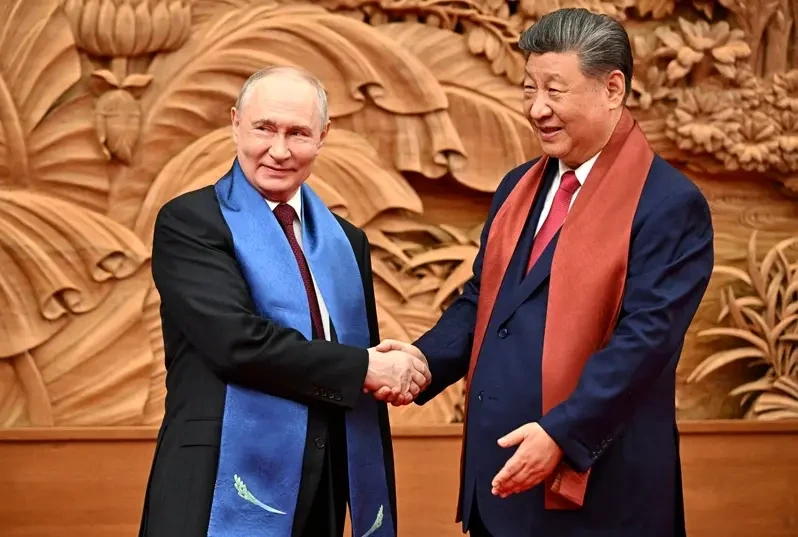
At the APEC leaders’ meeting in Shenzhen, Vladimir Putin emphasized that Russia will continue to deepen its cooperation with Asia-Pacific economies. He expressed support for the draft “Shenzhen Declaration” and outlined plans to expand Russia’s regional influence through collaboration in energy, trade, logistics, and digital technology.
Speaking on the 19th at the informal APEC leaders’ meeting in Shenzhen, Russian President Vladimir Putin stated that developing constructive partnerships with economies in the Asia-Pacific region is a strategic priority for Russia. In the first eight months of this year, Russia’s trade volume with Asia-Pacific economies grew by nearly one-third, while trade with ASEAN nations has increased by nearly 60% over the past decade. Putin further affirmed Russia’s support for the draft “Shenzhen Declaration.”
During the meeting, Putin noted that as the global economy faces fragmentation and mounting challenges to economic stability, the APEC forum should serve as a unifying force to establish a constructive agenda for cooperation. He indicated that the draft “Shenzhen Declaration”—currently under review—aims to achieve this, and that Russia supports the document. The Asia-Pacific region has emerged as a vital engine for global economic development, with continuous improvements in production, technology, and logistics capabilities. It is projected that APEC member economies will see an economic growth rate of 4.8% this year—a figure significantly higher than the global average.
Putin stated that Russia is an integral part of the Asia-Pacific region and has made significant contributions to its prosperity. In the first eight months of this year, Russia’s trade with Asia-Pacific economies grew by nearly one-third, with a focus on non-energy and innovative products. Over the past decade, total trade between Russia and ASEAN member states has increased by nearly 60%.
He also noted that the network of preferential trade agreements between Asia-Pacific nations and the Eurasian Economic Union (EAEU) continues to expand. Russia is actively promoting the establishment of a “Greater Eurasian Partnership,” aiming to create a seamless economic space across the Eurasian continent. This partnership is envisioned as a core integrative framework connecting the EAEU, the Shanghai Cooperation Organization (SCO), and ASEAN.
Addressing the topics of energy and food, Putin remarked that Russia supplies the Asia-Pacific region with energy, substantial quantities of grain, and mineral fertilizers, thereby contributing to the region’s energy and food security. He further emphasized that trading partners can rely on the dependability, quality, and stability of Russian supplies.
Putin stated that Russia is committed to remaining open to the world while strengthening its own economic power. This involves pursuing fundamental domestic reforms, enhancing industrial infrastructure and technological capabilities, and keeping inflation under control. Russia has significantly adjusted its domestic economic structure, prioritizing the development of advanced industries, digital technologies, artificial intelligence (AI), and nuclear energy. Over the past three years, Russia’s real GDP has grown by more than 10%, and in terms of purchasing power parity (PPP), Russia firmly ranks among the world’s major economies.
Regarding transport and logistics, Putin noted that Russia is strengthening its transport and transit networks—including the eastern rail arteries, the International North-South Transport Corridor (INSTA), and the Northern Sea Route—and has invited APEC economies to make greater use of these new logistics routes. Some partners have already begun participating in these efforts.
Putin also indicated that Russia intends to cooperate closely with APEC members in knowledge-intensive industries, particularly in the peaceful use of nuclear energy. Russia is also prepared to share digital solutions and AI technologies with its Asia-Pacific partners, provided that such cooperation safeguards national sovereignty and data security. Russia will continue to actively participate in APEC’s work and collaborate with other forum members to advance mutually beneficial projects and initiatives. Over the past few decades, Russia has pursued more than 80 large-scale joint projects with its partners, spanning areas such as agricultural production and trade, as well as e-government services.